
Operational income not covering even their interest expenses, finds study; analysts say if economy turns around, new equity issuances an option
Hindalco's first quarter (Q1FY23) results indicate healthy domestic volumes for aluminium and copper, and lower cost of production. Subsidiary Novelis saw weak volume trends but it managed to push operating profit margins on a better mix and pricing hikes. The weak global outlook on aluminium is a cause for ongoing concern.

Proceedings for imposing safeguard duty on Chinese Nylon Tyre Cord Fabric have already been initiated by the DGS on February 6 this year. Significantly, these moves to protect the domestic industry come at a time when India's industrial production contracted for two consecutive months ending January, 2009.

Manufacturing activities in India accelerated further and touched a four-month high in April, boosted by robust new business growth, mild price pressures, better international sales, and improving supply-chain conditions, a monthly survey said on Monday. The seasonally adjusted S&P Global India Manufacturing Purchasing Managers' Index (PMI) increased from 56.4 in March to 57.2 in April, indicating the fastest improvement in the health of the sector so far this year. The March PMI data pointed to an improvement in overall operating conditions for the 22nd straight month.

The rally in silver may continue if the global economic recovery remains on course.

'The failures of private businessmen have set back the process of market-oriented reform, though that is the only way forward,' argues T N Ninan.

Sensex is trading firm; FMCG, real estate going strong.

The recent surge in crude oil prices could shave off the gains made by India Inc in profit margins in the past few quarters. Worse, it comes at a time when consumer demand in the country is slipping and major global economies are witnessing a slowdown. A back-of-the-envelope calculation suggests that the margin expansion accounted for three-fourths of the rise in the listed firms' operating profit between the April-June quarter (Q1) of FY23 and Q1FY24, and only a quarter of profits gains came from revenue growth.

The NSE Nifty closed at 5250, down 9 points. The market breadth was neutral. Out of 2991 stocks traded on the BSE, there were 1406 advancing stocks as against 1514 declines.

Among the Sensex firms, Bajaj Finserv, Tata Motors, Asian Paints, ITC, IndusInd Bank, State Bank of India, Tata Steel, Wipro, Infosys and Maruti were the major gainers. Tech Mahindra, HCL Technologies, Kotak Mahindra Bank, Titan and Larsen & Toubro were the major laggards.

The Nifty ended at 5,317 - with a loss of 37 points. BSE market breadth was marginally negative. Out of 2,982 stocks traded, 1,543 declined while 1,323 advanced.

Notwithstanding expectations of a pick-up in construction activity during a seasonally strong January-March quarter (fourth quarter) of 2022-23 (FY23), analysts are cautiously optimistic about the building material sector - encompassing paints, pipes, wood panels, tiles, metals, and cement - as volatile input costs, coupled with fears of a global slowdown, are making demand projections uncertain. Against this backdrop, analysts suggest investors stay selective and pick stocks of companies with stronger brand recall, expanding distribution network, diversified product profile, healthier balance sheet, and sustainable cash flow. "The government's various proposals under Budget 2023-24 (FY24) may lead to the building material segment growing between 8 per cent and 12 per cent for the next five years.

Equity indices overcame a wobbly start to clock gains for the third session on the trot on Tuesday, propped up by banking, metal and energy stocks amid a mixed trend in global markets. A recovery in the rupee also bolstered sentiment, traders said. The 30-share BSE Sensex advanced 246.47 points or 0.45 per cent to settle at 54,767.62 after starting the trade on a weak note. In a volatile session, the benchmark hit a high of 54,817.52 and a low of 54,232.82 during the day.
Equity indices staged a pullback on Tuesday after three days of declines as investors scooped up IT, metal and consumption stocks amid a largely positive trend overseas. A recovery in the rupee added to the momentum, traders said. Overcoming a wobbly start, the 30-share BSE Sensex climbed 274.12 points or 0.45 per cent to settle at 61,418.96.
About 1,556 shares have advanced, 1,211 shares declined, and 182 shares are unchanged.
Equity benchmark indices Sensex and Nifty buckled under selling pressure after a nine-session rally on Monday, as massive sell-off in IT, tech and telecom counters unnerved investors.

Cascading effect of rising raw materials will result in inflation, high rates, slow capex
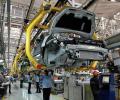
Automobile manufacturers are likely to report strong numbers for the September quarter of Financial Year 2023-24 (Q2 FY24), riding on growth across segments and offset by a marginal drop in overall two-wheeler (2W) volumes. Higher average selling price (ASP) year-on-year (YoY), which was necessitated by price hikes taken by original equipment manufacturers (OEMs), and an improved product mix will also aid revenues and margins. Moreover, commodity prices are down on a YoY basis, leading to higher margins in earnings before interest, taxes, depreciation and amortisation (Ebitda).
The Centre for Monitoring Indian Economy revised upwards its industrial forecast for 2003-04 by 1% to 5.5% as the food sector is expected to show a positive 3% growth as against the earlier projection of a decline of 0.4%.
The Indian equity market is likely to see one of its worst phases, with most sectors expected to report a decline in earnings or single-digit earnings growth in Q4 FY'09, a leading broking firm said in its report.

Expenditure on new projects slowed down for the second quarter in a row amid an uncertain global environment and higher borrowing costs. There were new projects worth a cumulative Rs 3.26 trillion in the July-September period, according to data provided by project tracker Centre for Monitoring Indian Economy (CMIE). This figure is much less than Rs 4.39 trillion in the June quarter (Q1FY23) and Rs 8.46 trillion in the March quarter (Q4FY22).
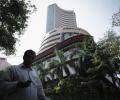
Broader markets underperformed indices with BSE Midcap down 0.43% while the Smallcap index fell 0.07%.

The adverse impact on the margins of auto, consumer staples and consumer durables sectors will be counterbalanced by an earnings uptick in the metals, cement and oil & gas sectors.

Prime Minister Narendra Modi on Sunday called for a global framework for ethical use of Artificial Intelligence (AI) as he flagged concerns surrounding bias in such modern technologies and their impact on the society. Days ahead of the G20 Summit, the prime minister also made a strong case for developing an integrated approach to deal with issues concerning cryptocurrencies. Modi, addressing B20 Summit India 2023 organised by CII, said India is preparing a global framework for Green Credit and urged industry leaders to adopt life and businesses with emphasis on planet positive actions.

From the Sensex pack, JSW Steel, Tata Steel, NTPC and UltraTech Cement emerged as major winners, closing the day with a gain of up to 3.33 per cent. On the other hand, Asian Paints, ITC, L&T and SBI were the laggards, ending the session up to 3.95 per cent lower. Of the 30 Sensex stocks, 14 closed the day in green, while on the 50-stock index Nifty 25 scrips ended with gains.

Benchmark BSE Sensex rose by 156 points while the Nifty closed above the 17,300 level on Thursday after gains in metal, IT and capital goods shares amid foreign capital inflows. The 30-share BSE benchmark gained 156.63 points or 0.27 per cent to settle at 58,222.10. During the day, it jumped 513.29 points or 0.88 per cent to 58,578.76.

Given that the ETF has given exceptional returns over the past year, start small and buy more in a staggered manner.

The sharp correction in the Indian markets from their peak levels has made valuations attractive, say analysts, who advise buying selectively, but only from a long-term perspective. Fifty-six of the Nifty 100 stocks, according to Mahesh Nandurkar, managing director at Jefferies, now trade below the 10-year historical averages, including stocks in financial, select auto, and pharma sectors. "Valuation (one-year forward consensus price-to-earnings, PE) has declined 25 per cent from October 2021 peak, almost matching the 33 per cent price-earnings contraction during the 2011 tightening cycle when repo rates went up by 375 basis points (bps) versus 250 bps this cycle.

Modi called business communities and governments to work together to ensure usage of ethical AI as "we have to sense the potential disruptions in different sectors. This problem has to be solved under the global framework."

Among the Sensex firms, Kotak Mahindra Bank, Tata Steel, ITC, ICICI Bank, Bajaj Finserv, Maruti, Mahindra & Mahindra and State Bank of India were the biggest winners. Tata Consultancy Services, Infosys, HCL Technologies, Tech Mahindra, Asian Paints, Wipro and Tata Motors were the biggest laggards.

'Investors should look to incrementally allocate towards equity from a medium-to-long term horizon.'
 © 2026 Rediff.com - Advertise with us - Disclaimer - Privacy Policy - Sitemap - Feedback - About us - Terms of use - Grievances